We are a group of adults, who are interested in local and family history. We have met for the last eight years since 1999, to study and research about the local history of Tameside and Manchester and to learn and practise the skills needed to study local history. Led by Alan Rose and Jill Cronin, we have attended courses in each autumn and spring terms and then enjoyed various walks and visits during the summer.
Together we have produced books about Carrbrook, Charlestown, and Hartshead with Broadcarr, plus placed our research about Gee Cross in Ashton Local Studies Library. More recently we decided to record the area around Henry Square in Ashton before demolition and then development took place. The result is our latest book ‘Smokestack to Urban Chic’.
New Book Published September 4th
'Smokestack to Urban Chic'
St Petersfield, Ashton-under-Lyne
The Story of St Petersfield (the area of Ashton around the Magistates' Court) from its beginnings in the 1820s to its recent transformation to ultra modern offices and apartments. It has been compiled by the 'History on Your Doorstep' group which meets on Thursday afternoons at Ashton Central Library. Its hundred pages are crammed with illustrations of buildings that have now disappeared, along with stories and memories of the Baths in Henry Square, the Shops, the Mills, Williamsons ticket works, the Murphy Riots of 1868 and much more.
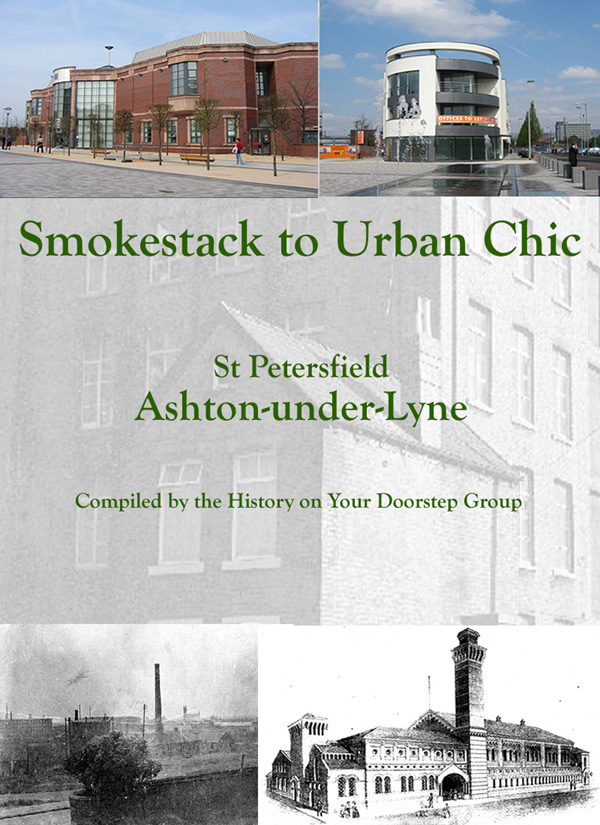
Copies are £10.00 and available from Mr W Johnson, click here for a printable application form
All the proceeds from the sale of this book will be donated to the History Forum to help fund other projects.
We have decided to have a rest from publishing and to enjoy our classes instead! Last year we looked at the important families of Tameside and then a snapshot of the development of each town in Tameside. During the summer we visited the new museum at Fairfield Moravian Settlement and also Upper Mossley plus St George’s Church.
We begin again in the autumn on Thursday September 24th, when we shall look at various Tameside themes such as Poverty and the Workhouse; Education; Law and Order; Shopping.
A Trio of Local History Projects. or
Three Books and a Couple of Dozen Authors.
This piece is about some of the triumphs and pitfalls involved in communally written projects. But first of all a word of caution on the subject.
We, most of us, have lifelong codes,
Much more to us in life than modes,
So, to us, Democracy
Is just as right as drinking tea,
But using such to write a book
Needs, patience, tolerance and luck,
So scholars all ‘fore taking pens,
Have care ‘bout doing it in tens.
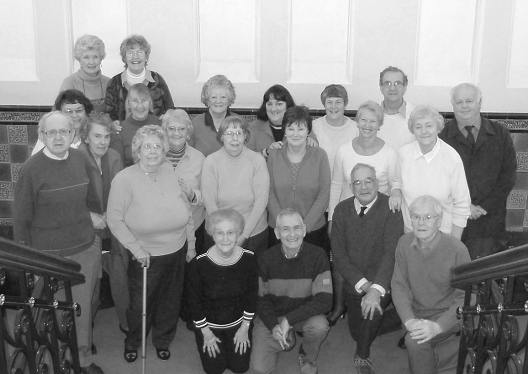
The W.E.A. History on Your Doorstep Ashton Group under the guidance of their eminences (tutorically and historically speaking) Jill Cronin and Alan Rose, has been in existence for about six years and during that time numbers have never fallen below twenty and, at times, have been as high as thirty. Upwards of fifteen of us have been with the group since its inception - so one could say that for us our weekly class is as much a ‘history social’ as a study of social history.
Many of the group have become expert and knowledgeable in aspects of local history and one of the many joys of the class is the enthusiastic sharing of information, which takes place weekly.
This year, having squeezed much of the juice (history wise) out of Tameside we have expanded our horizons to cover the whole of Greater Manchester.
Some three years ago we applied our newfound knowledge in a whole class project relating to the history of Joel Lane in Hyde and the subsequent results of our efforts were placed in the Local History Library.
Having accomplished this first project, and based on our experience of the problems of working in a mega group, for a second, we elected to split into more manageable teams of seven to ten people. So after some discussion persuasion, coercion etc we elected to study three areas of Tameside namely Carrbrook, Charlestown and Hartshead with individual groups choosing each area.
It soon became apparent that three more different areas could not have been chosen and this very much coloured the way in which each of the groups tackled its project.
The Charlestown group of up to ten people (including for a time that doyen of Tameside Students of History Hubert King) had the distinct problem that there are now very few tangible remains of this once thriving area of inner town Ashton. To balance this however they found huge amounts of historical information both documented and more interestingly in the shared memories and reminiscences of many local people.
It would probably be true to say that this book has generated more conversations between authors, purchasers and readers beginning with - ‘Charlestown yes I remember ---’ than any other.
The Hartshead area on the other hand, with its dispersed rural environment, is probably the least changed of the three as far as its historical fabric is concerned. This group of six, as it turned out mainly local people, were able to look at the buildings and communities of Hartshead and Broadcarr and to trace the histories of families and buildings in an almost Travelogue style. Because many of the residents of the area have lived in their houses for years the project generated huge interest in the area and the group received an enormous amount of help from local people.
The Carrbrook area project, tackled by a group of seven people, showed significant differences from the other two as a result of its previous existence as an industrial community set in an isolated (originally) rural environment.
Although many of the area’s 17/18th Century buildings still exist, as does the magnificent late 19th/early 20th Century Print Works built Village - the latter now surrounded by post 1970 developments - there is now very little physical evidence of the industries which, for upwards of two hundred years, were its Raison D’etre’.
Similarly there is now little indication of the sense of isolation and separateness, which, even as late as the 1970s, was so much a feature of this place.
Given that the Print Works was only closed in the living memory of many of the present inhabitants, coupled with the work being done by the Carrbrook Heritage Committee, this project tended to concentrate on aspects of the pre 1900 history of Carrbrook rather than the 20th C.
The somewhat bucolic early progress of the projects was shaken in mid flight by the startling news in late 2003 that we had received a grant towards the publication of our works and hence had a deadline, which wasn’t in the dim and distant future. This meant that final drafting, correcting, printing and launching went by in a blur of activity. We owe thanks for help to the many people who contributed directly or indirectly to the books but particularly to Jill and Alan, to Alice Lock and her team at the Local Studies Library and to the Tameside Heritage Development Fund without whose financial support it is unlikely that these projects would have come to fruition.
So what did we gain/learn from as a result of our labours? Well the difficulty of applying the aforesaid principle of democracy to the writing of books in concert for a start. Having said this we did gain huge satisfaction, some small financial gain and a great deal more knowledge about our chosen areas than before we started.
We also finished the projects with clearer ideas of the ways in which multiple authorship should be approached – that is to say we subsequently gained these clearer ideas which is not the same as saying that we applied them.
So, based on our experience, here are some of the principles we think SHOULD be applied:-
At a very early stage a clear idea of the way the book should turn out, rather than allowing a process of evolution, should be the order of the day. This is called the ‘On Pain of Death Planning Policy’.
The group needs to have a strong joint editorial policy or better still an Editor – not an easy job for a mere mortal. This approach is very good for people who like to exercise their lungs as it involves much discussion.
Perhaps thought should be given to making the book a compendium of individual efforts where the group is (almost) only allowed to put commas into other people’s work. This is particularly good for the people who don’t like arguments.
Finally, and most importantly of all, of all remember that, in spite of what it says in the Bible, it is unlikely that the meek will inherit the earth in our lifetimes.